Trading sessions and daylight saving time: why fixed UTC times drift
Asia, London and New York explained – and why the US and Europe switching clocks on different dates moves your session boxes for weeks every year.
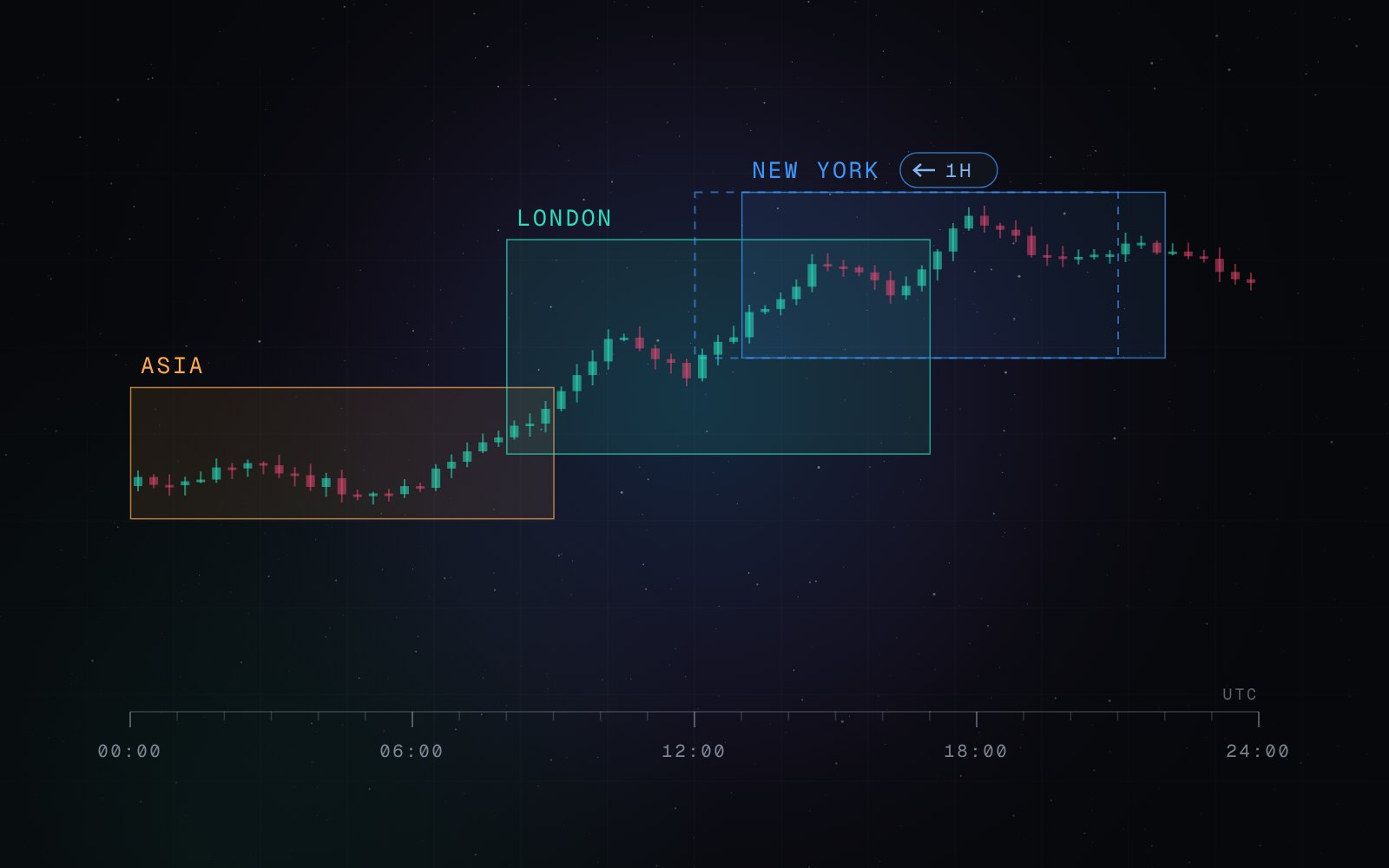
Markets like forex and crypto trade almost around the clock, but activity is not spread evenly. It follows the business hours of the big financial centres. That is why traders mark sessions on their charts.
The three main sessions
- Asia, with Tokyo as the reference: often calmer, with smaller ranges in many markets.
- London: the largest forex trading centre; volatility usually picks up when it opens.
- New York: active from the US morning; the overlap with London is often the busiest part of the day.
For exchange-traded markets the official hours are clear, for example the New York Stock Exchange from 9:30 to 16:00 New York time. For forex, session times are conventions and differ slightly between sources.
The daylight saving problem
The United States and Europe switch to summer time on different dates. The US moves its clocks forward on the second Sunday in March and back on the first Sunday in November. The EU switches on the last Sunday in March and the last Sunday in October. Japan does not use daylight saving time at all.
The result: for about two to three weeks in spring and one week in autumn, the time difference between London and New York is four hours instead of five. A tool that draws sessions at fixed UTC times will place them wrong during these weeks – and for the rest of the year it is off by an hour for at least one of the centres.
Exchange local time stays right
The reliable way is to define each session in the local time of its city – London in London time, New York in New York time – and let the clock rules of each place handle summer and winter. Then a session that opens at 8:00 in London always opens at 8:00 London time, whatever the date.
How to use sessions
- Look at the high and low of a session: later price often comes back to them.
- Compare how much the market moved in each session before you judge a breakout.
- Check your chart’s time zone setting so the session boxes match what you expect.
- Sessions show when the market is active – and mark the levels that matter for the day.
Educational content. It is not investment advice and not a recommendation to buy or sell. Risk disclosure