Risk management: position size, stop loss and the 1 % rule
The part of trading that keeps you in the game: sizing a position from your stop, why risk-reward matters and which limits protect your account.
Strategies differ from trader to trader. What successful traders have in common are clear risk rules – they keep you in the market long enough for your edge to play out.
Risk a fixed share per trade
Many traders risk between 0.5 % and 2 % of their account on a single trade; 1 % is a common starting point. With 1 % per trade, ten losses in a row cost about 10 % of the account. With 10 % per trade, the same streak would cost about 65 %. Small, fixed risk is what makes losing streaks survivable.
Position size from the stop
Position size = risk amount ÷ (stop distance × value per point). An example for an account in US dollars: 10,000 USD account, 1 % risk = 100 USD. EURUSD stop of 25 pips, one standard lot is worth 10 USD per pip. 100 ÷ (25 × 10) = 0.4 lots. The wider the stop, the smaller the position – the risk in dollars stays the same.
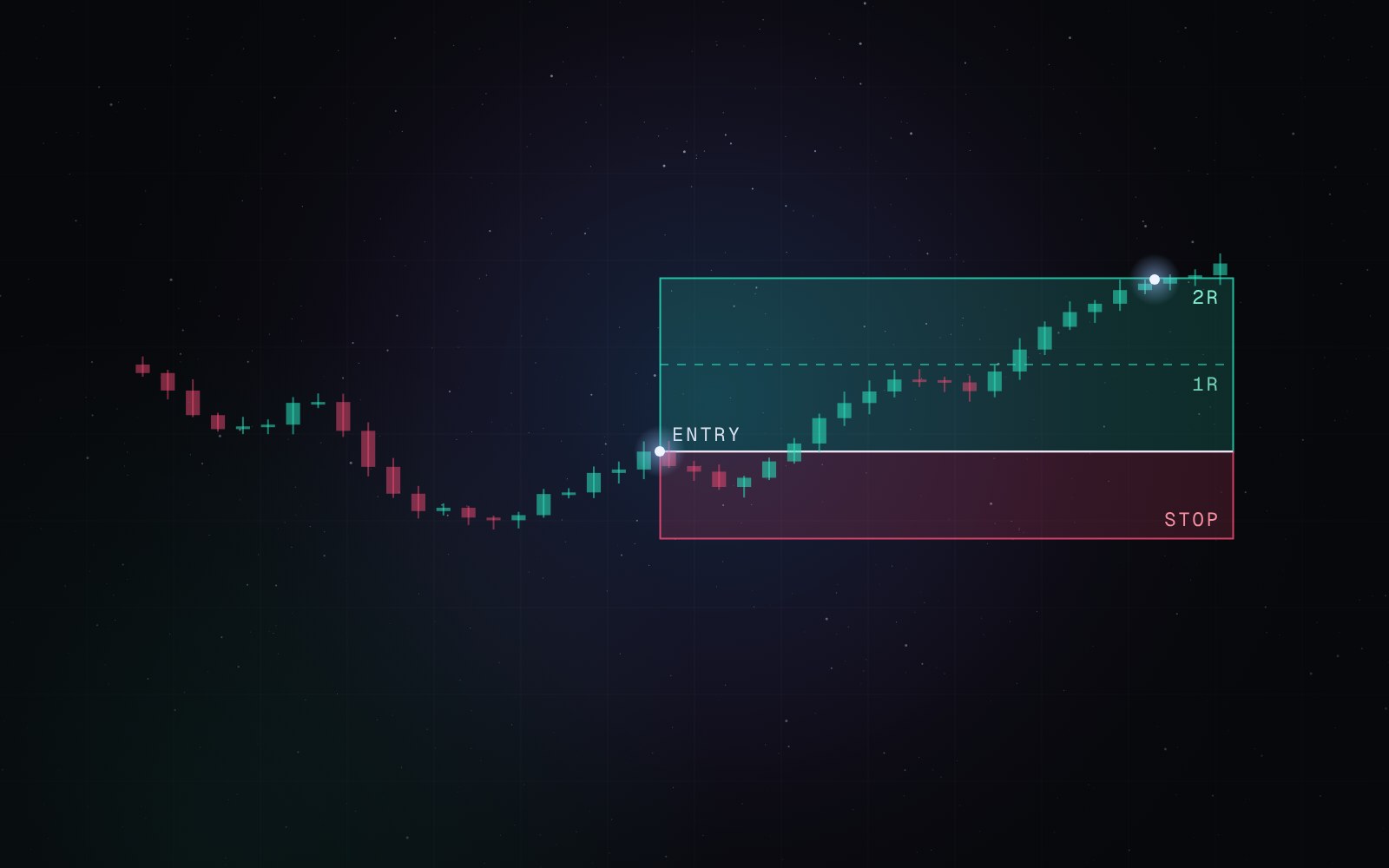
Stop first, then target
Place the stop where your trade idea is wrong – beyond the swing, the zone or the order block – not at a random distance. Then check the target. With a risk-reward ratio of 1:2 you make 200 for every 100 you risk.
- 1:1 – you need to win more than half of your trades to be profitable.
- 1:2 – a win rate above about 33 % is profitable.
- 1:3 – a win rate above about 25 % is profitable.
Limits that protect your account
- A daily loss limit, for example 3 % – after that, the day is over.
- A maximum for the total open risk across all trades.
- Correlated markets count as one position, for example EURUSD and GBPUSD.
- A short break after several losses in a row.
Keep a journal
Write down entry, stop, target, the result in R and a screenshot for every trade. After 30 or more trades you see clearly which setups work for you – and which ones you can drop.
Educational content. It is not investment advice and not a recommendation to buy or sell. Risk disclosure